- Shabhana s
- digital marketing, Email Campaign Manager, Email Campaigns, Email Marketing, Email Marketing Skills, Email Marketing Strategy, Marketing Automation
- 0 Comments
- 13 Views
Email marketing remains an important digital marketing channel for businesses that want to communicate directly with customers and prospects. From newsletters and promotional campaigns to automated customer journeys, email can support different stages of the customer relationship.
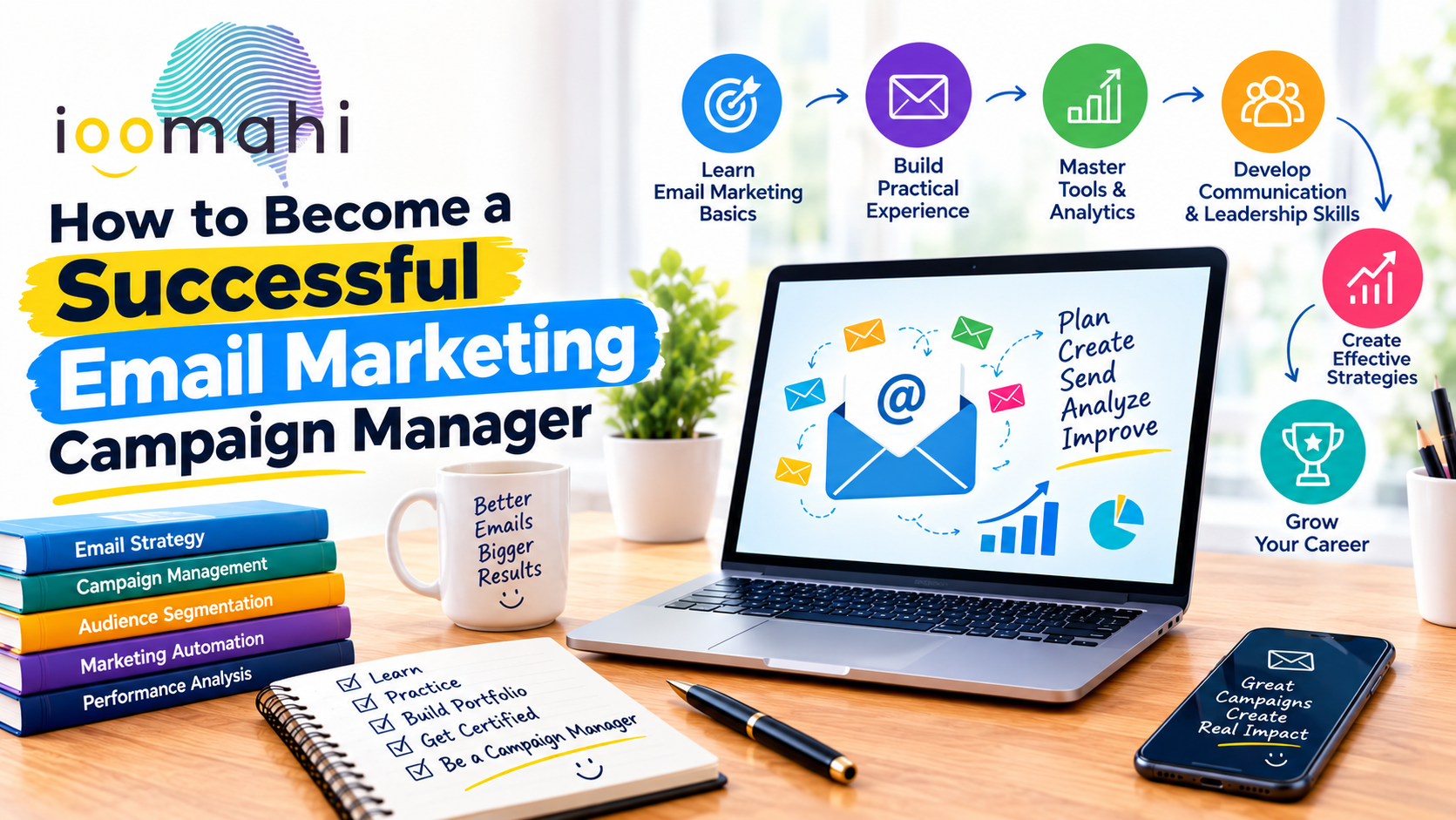
An email marketing campaign manager is responsible for planning, coordinating, executing, analyzing, and improving email campaigns. The role combines creativity with data analysis, marketing strategy, copywriting, audience segmentation, automation, and technical knowledge.
Becoming successful in this field requires more than knowing how to send an email. You need to understand your audience, create relevant messages, maintain healthy email practices, analyze campaign performance, and continuously test new approaches.
Whether you are starting a digital marketing career or moving into email marketing from another role, developing the right combination of technical and creative skills can help you build a strong professional foundation.
What Does an Email Marketing Campaign Manager Do?
An email marketing campaign manager oversees the different stages of an email campaign.
Depending on the organization, responsibilities may include:
- Developing email marketing strategies
- Creating campaign calendars
- Defining target audiences
- Managing subscriber lists
- Writing or coordinating email copy
- Planning email designs
- Creating automated workflows
- Managing campaign platforms
- Testing emails before sending
- Monitoring campaign performance
- Preparing performance reports
- Improving future campaigns
The role may also involve working closely with content, sales, design, product, and customer-success teams.
Why the Role Is Important
Sending large volumes of emails without a clear strategy can result in low engagement and poor customer experiences.
A campaign manager helps ensure that the right audience receives relevant communication at an appropriate stage of the customer journey.
Step 1: Learn the Fundamentals of Email Marketing
Start by understanding the basic principles behind successful email campaigns.
Important concepts include:
- Subscriber acquisition
- Email list management
- Audience segmentation
- Personalization
- Email copywriting
- Campaign scheduling
- Marketing automation
- Deliverability
- A/B testing
- Conversion tracking
Understanding these fundamentals will make it easier to use email marketing platforms effectively.
Understand the Customer Journey
Email campaigns should be connected to the customer’s relationship with the brand.
For example, a business may create different communications for:
- New subscribers
- First-time customers
- Returning customers
- Inactive subscribers
- Potential customers
- Long-term customers
Each group can have different needs, which means the same email should not necessarily be sent to everyone.
Step 2: Develop Strong Copywriting Skills
Email marketing depends heavily on communication.
A campaign manager should know how to write subject lines, preview text, headlines, body copy, calls to action, and concise promotional messages.
Effective email copy should communicate the main value clearly and encourage the reader to take an appropriate next step.
Write for the Reader
Avoid filling emails with unnecessary information. Instead, focus on the recipient’s needs and explain how the product, service, information, or offer is relevant to them.
A strong email generally has a clear purpose rather than trying to communicate several unrelated messages at once.
Read here – How to Become an Email Marketing Consultant: Beginner’s Guide
Step 3: Learn Audience Segmentation
Segmentation involves dividing an email audience into groups based on relevant characteristics or behavior.
Segments can be created using information such as:
- Purchase history
- Geographic location
- Website activity
- Content interests
- Customer lifecycle stage
- Engagement behavior
- Product preferences
For example, an online store could send a product recommendation to customers based on previous purchases rather than sending the same message to its entire database.
Relevant segmentation can make campaigns more targeted and useful.
Step 4: Understand Email Automation
Automation allows marketers to send specific messages based on predefined triggers, customer actions, or schedules.
Common automated campaigns include:
Welcome Emails
These introduce new subscribers to a brand and explain what they can expect.
Abandoned Cart Emails
E-commerce businesses may use these to remind customers about products left in their shopping carts.
Post-Purchase Emails
These can provide order information, product guidance, feedback requests, or relevant follow-up communication.
Re-Engagement Campaigns
These campaigns attempt to reconnect with subscribers who have become inactive.
Learning how to design automated customer journeys is an important skill for campaign managers.
Step 5: Learn Email Marketing Platforms
Practical experience with email marketing software is essential.
Popular platforms and tools can provide capabilities such as:
- Campaign creation
- Subscriber management
- Automation
- Segmentation
- Templates
- Analytics
- A/B testing
- Integrations
The specific platform used will depend on the organization and its technology stack.
Rather than learning only one interface, understand the underlying concepts so that you can adapt to different platforms.
Step 6: Understand Email Design and User Experience
A campaign manager does not necessarily need to become a professional designer, but understanding email design principles is valuable.
Emails should generally be:
- Mobile-friendly
- Easy to scan
- Visually consistent
- Clearly structured
- Accessible
- Focused on one primary action
Use appropriate headings, spacing, images, buttons, and text hierarchy to make the message easy to understand.
Test Across Devices
An email that looks good on a desktop may not provide the same experience on a smartphone.
Before sending important campaigns, review how the email renders across relevant devices and email clients.
Step 7: Learn Email Deliverability
Deliverability is a critical part of email marketing.
A campaign manager should understand concepts such as:
- Sender reputation
- Bounce rates
- Spam complaints
- Authentication
- List hygiene
- Engagement
- Unsubscribe management
Modern email programs commonly use authentication mechanisms such as SPF, DKIM, and DMARC to help establish legitimate sending practices.
Following applicable email marketing laws, platform requirements, and consent practices is also essential.
Read this – Email-Newsletter-smaller
Step 8: Master Email Marketing Analytics
Successful campaign managers make decisions using data.
Important metrics can include:
- Delivery rate
- Open rate
- Click-through rate
- Click-to-open rate
- Conversion rate
- Bounce rate
- Unsubscribe rate
- Revenue attributed to campaigns, where applicable
Metrics should be interpreted in context. For example, a high open rate does not necessarily mean that a campaign generated strong business results.
Focus on Business Objectives
Different campaigns have different goals.
A newsletter may prioritize engagement, while an e-commerce campaign may focus on purchases. A lead-nurturing campaign may be designed to move prospects toward a sales conversation.
Choose metrics that reflect the actual objective of the campaign.
Step 9: Learn A/B Testing
A/B testing involves comparing different versions of an email or campaign element to determine how audiences respond.
You can test elements such as:
- Subject lines
- Calls to action
- Email copy
- Images
- Offers
- Layouts
- Send timing
Avoid changing too many variables simultaneously when you want to understand what caused a performance difference.
Use test results as evidence for future campaign decisions rather than assuming that one successful experiment will work identically in every situation.
Step 10: Build Project Management Skills
Email campaigns often involve several people and deadlines.
You may need to coordinate with:
- Copywriters
- Designers
- Developers
- Sales teams
- Product teams
- Marketing managers
- Compliance teams
Create a campaign workflow that covers briefing, writing, design, review, testing, approval, scheduling, and reporting.
A detailed checklist can help reduce errors such as incorrect links, missing personalization, outdated offers, or incorrect audience selection.
Step 11: Build a Professional Portfolio
If you want to pursue email marketing as a career or freelance service, create a portfolio that demonstrates your abilities.
You can include:
- Sample email campaigns
- Welcome sequences
- Promotional emails
- Newsletter examples
- Automated workflows
- Segmentation strategies
- A/B testing examples
- Performance reports
When using real client work, obtain appropriate permission before displaying confidential information.
Demonstrate Your Thinking
A portfolio becomes more useful when it explains the objective, audience, strategy, execution, and measurable results where those results can legitimately be shared.
Step 12: Keep Learning
Email marketing continues to evolve alongside changes in technology, privacy practices, automation, customer behavior, and marketing platforms.
Follow industry developments, study successful campaigns, experiment with your own projects, and regularly update your knowledge.
Developing complementary skills in analytics, content marketing, CRM, SEO, paid advertising, and customer journey strategy can also broaden your career opportunities.
Read this – Email Campaign Manager
Common Mistakes to Avoid
Sending Emails Without a Clear Goal
Every campaign should have a defined objective.
Ignoring Segmentation
Sending identical messages to every subscriber can reduce relevance.
Using Misleading Subject Lines
Subject lines should accurately represent the email’s content and avoid deceptive tactics.
Neglecting Mobile Optimization
Poor mobile experiences can make otherwise useful campaigns difficult to read or interact with.
Focusing Only on Open Rates
Open rates are only one measurement. Consider clicks, conversions, revenue, engagement, and other objectives that matter to the campaign.
Ignoring Unsubscribes and Complaints
Subscriber feedback and negative engagement signals can provide important information about email relevance and list health.
Key Takeaways
- Learn the fundamentals of email marketing before managing complex campaigns.
- Develop strong copywriting and communication skills.
- Use audience segmentation to improve relevance.
- Understand automation and customer journeys.
- Gain practical experience with email marketing platforms.
- Learn the fundamentals of email design and mobile optimization.
- Understand deliverability, authentication, and responsible list management.
- Use analytics to measure campaign performance.
- Experiment with A/B testing and apply the findings.
- Build a portfolio that demonstrates practical campaign-management skills.
- Continue learning as email technology and customer expectations evolve.
Conclusion
Becoming a successful email marketing campaign manager requires a combination of marketing knowledge, creativity, technical understanding, analytical thinking, and organizational skills. The role goes far beyond scheduling newsletters or promotional emails.
Start by learning the fundamentals, then develop practical skills in copywriting, segmentation, automation, design, deliverability, analytics, and testing. Build sample campaigns and real-world experience so you can demonstrate how your decisions contribute to specific marketing objectives.
Most importantly, treat email marketing as a customer communication channel rather than simply a promotional tool. When campaigns are relevant, well-timed, measurable, and aligned with customer needs, they can become an important part of a broader digital marketing strategy.