- Shabhana s
- Brand Awareness, Business Marketing, Content Marketing, Digital Advertising, digital marketing, Digital Marketing vs Traditional Marketing, Marketing Strategy 2026, Marketing Trends 2026, Offline Marketing, Online Marketing, SEO Marketing, Social Media Marketing, Traditional Advertising, Traditional Marketing
- 0 Comments
- 24 Views
Businesses have more ways to reach customers today than ever before. From Google searches and social media advertisements to television commercials, newspapers, billboards, and direct mail, companies can choose from a wide range of marketing channels. However, deciding between digital marketing vs traditional marketing is not always straightforward.
Digital marketing uses internet-based channels to connect businesses with potential customers, while traditional marketing relies on established offline media. Both approaches have advantages and limitations, and the right choice depends on factors such as target audience, industry, budget, business objectives, and campaign requirements.
In 2026, many businesses are moving beyond the idea of choosing only one approach. A well-planned combination of digital and traditional marketing can help brands increase awareness, reach different audiences, generate leads, and build long-term customer relationships.
What Is Digital Marketing?
Digital marketing refers to marketing activities conducted through digital channels and technologies.
Businesses can use digital marketing to reach audiences through platforms such as search engines, websites, social media, email, mobile applications, online advertising, and other internet-based channels.
Common Digital Marketing Strategies
Some of the most widely used digital marketing methods include:
- Search Engine Optimization (SEO)
- Search engine advertising
- Social media marketing
- Email marketing
- Content marketing
- Influencer marketing
- Video marketing
- Affiliate marketing
- Display advertising
- Marketing automation
One of the biggest advantages of digital marketing is the ability to measure campaign performance using data and analytics.
Read here – Digital Marketing
What Is Traditional Marketing?
Traditional marketing refers to marketing methods that existed before the widespread adoption of internet-based advertising.
These methods typically communicate with audiences through offline media.
Common Traditional Marketing Channels
Traditional marketing can include:
- Television advertisements
- Radio advertisements
- Newspaper advertisements
- Magazine advertisements
- Billboards
- Brochures
- Flyers
- Direct mail
- Outdoor advertising
- Events and trade shows
Traditional marketing continues to be relevant, particularly for businesses targeting local communities, mass audiences, or consumers who respond strongly to offline brand exposure.
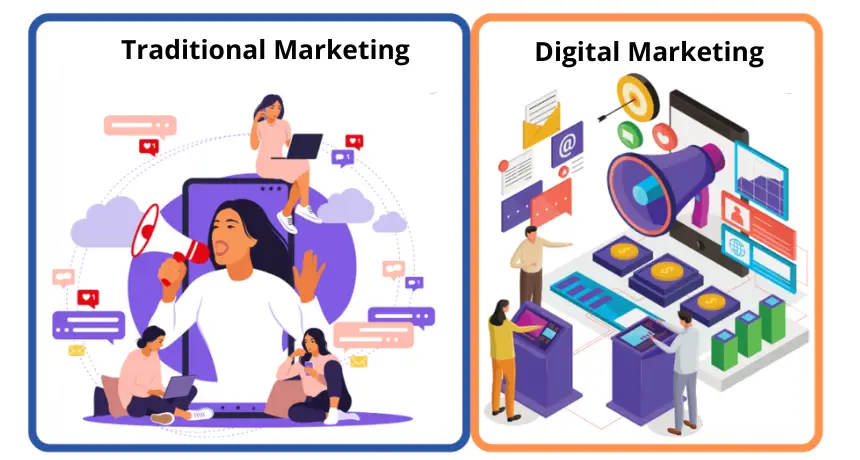
Digital Marketing vs Traditional Marketing: Key Differences
Understanding the differences between these two approaches can help businesses choose the right marketing mix.
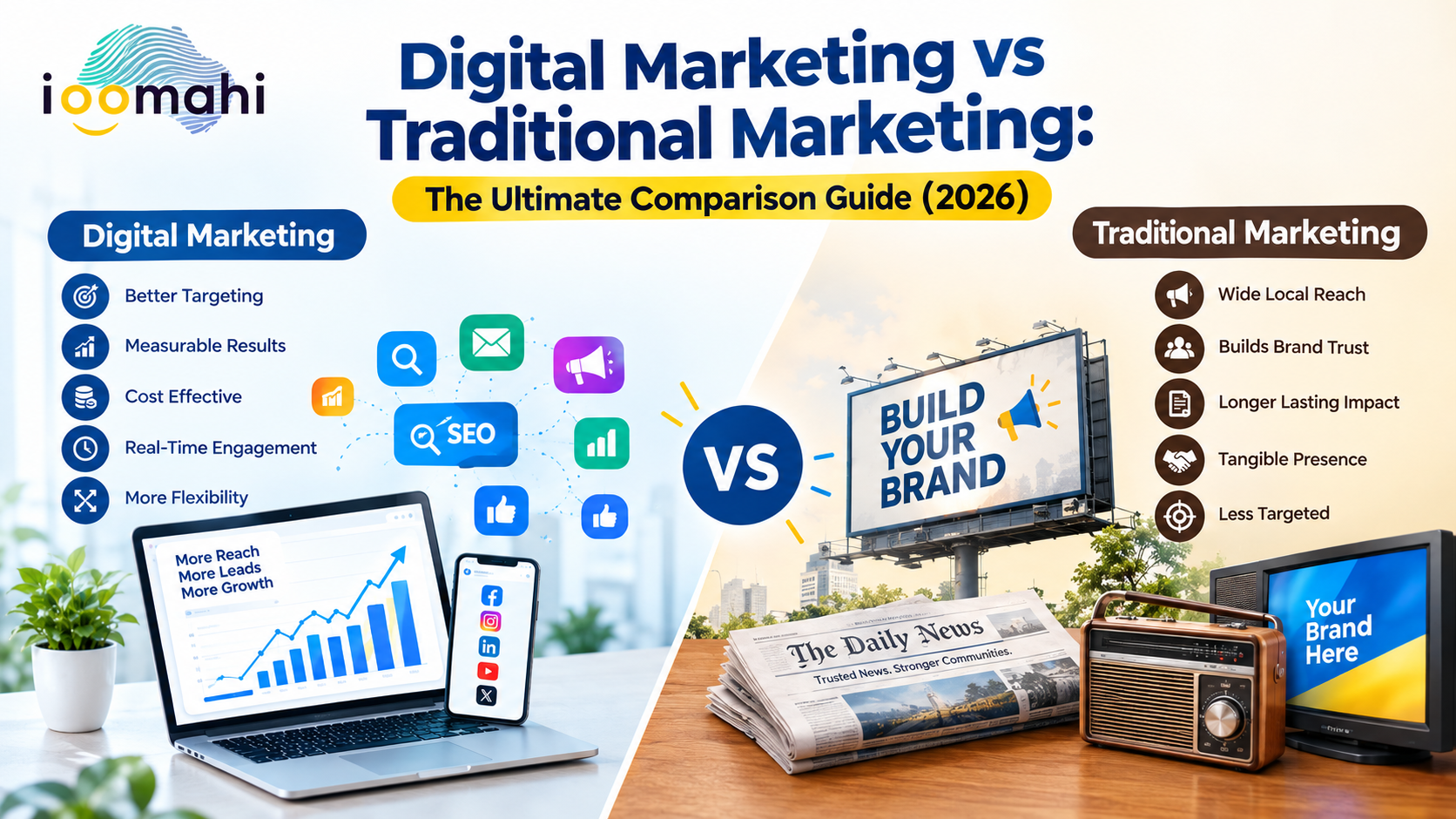
| Factor | Digital Marketing | Traditional Marketing |
|---|---|---|
| Primary channels | Websites, search engines, social media, email | TV, radio, newspapers, print, billboards |
| Audience targeting | Highly customizable | Generally broader |
| Measurement | Detailed analytics available | Often harder to measure precisely |
| Interaction | Two-way and highly interactive | Mostly one-way |
| Campaign flexibility | Changes can often be made quickly | Changes may require new production |
| Geographic reach | Local to global | Depends on the medium |
| Personalization | High | Usually limited |
| Content formats | Text, video, audio, interactive content | Print, audio, video, outdoor formats |
1. Audience Reach
Digital marketing can reach audiences across cities, countries, or even globally through internet-based platforms.
For example, an e-commerce company can promote its products to customers in multiple countries without establishing physical advertising infrastructure in each market.
Traditional marketing can also achieve significant reach. Television, radio, and large outdoor campaigns can expose a brand to thousands or millions of people, depending on the medium and location.
The difference is that digital campaigns generally provide more control over who receives the message
2. Targeting and Personalization
One of the strongest advantages of digital marketing is audience targeting.
Businesses can create campaigns based on factors such as demographics, interests, online behavior, location, search intent, and previous interactions, depending on the advertising platform and applicable privacy rules.
Traditional advertising typically reaches a broader audience based on the publication, broadcast, location, or media format.
For example, a billboard in a busy business district may reach a large number of people, but the advertiser has limited control over exactly who sees it.
3. Cost and Budget Flexibility
Marketing costs vary significantly based on the industry, channel, audience, location, and campaign scale.
Digital marketing can provide flexible entry points for small businesses. A company can start with a relatively small advertising budget, test different campaigns, and increase spending when results justify it.
Traditional marketing can require substantial upfront costs, particularly for television commercials, print campaigns, premium outdoor locations, and large-scale production.
However, traditional marketing should not automatically be considered expensive. Local flyers, community sponsorships, radio promotions, and targeted print campaigns can sometimes be cost-effective depending on the business.
4. Measuring Marketing Performance
Measurement is one of the major differences between digital and traditional marketing.
Digital campaigns can provide detailed performance data, including metrics such as:
- Website traffic
- Clicks
- Impressions
- Leads
- Conversions
- Engagement
- Cost per acquisition
- Return on advertising spend
This allows marketers to evaluate performance and adjust campaigns.
Traditional marketing can also be measured, but attribution may be more difficult. Businesses may need to rely on surveys, coupon codes, dedicated phone numbers, customer interviews, sales trends, or campaign-specific landing pages to estimate results.
5. Speed and Flexibility
Digital campaigns can often be launched, paused, modified, or optimized relatively quickly.
If an online advertisement is performing poorly, marketers can test a different headline, creative, audience, landing page, or offer.
Traditional campaigns are generally less flexible once production and distribution have begun.
For example, changing a printed brochure or television commercial may require new creative production and additional distribution costs.
6. Customer Interaction
Digital marketing gives businesses multiple opportunities to interact directly with customers.
Consumers can:
- Comment on social media posts
- Send direct messages
- Respond to emails
- Submit website enquiries
- Leave reviews
- Participate in online communities
- Engage with interactive content
Traditional marketing generally focuses more on delivering a message to an audience rather than creating immediate two-way communication.
However, events, exhibitions, retail experiences, and direct marketing can provide valuable offline interactions.
Read here – Integrated digital marketing solutions
Advantages of Digital Marketing
Wider Online Reach
Businesses can reach customers beyond their immediate geographic area.
Better Targeting
Digital platforms can offer sophisticated audience targeting and segmentation options.
Easier Performance Tracking
Analytics can help marketers understand how campaigns perform.
Personalization
Businesses can tailor messages and experiences to different customer segments.
Content Variety
Digital channels support text, images, video, audio, interactive content, and more.
Quick Optimization
Campaigns can often be adjusted based on performance data.
Advantages of Traditional Marketing
Strong Local Visibility
Offline channels can be particularly effective for local businesses.
Physical Brand Presence
Brochures, packaging, posters, signage, and direct mail provide tangible brand experiences.
Mass Awareness
Television, radio, newspapers, and outdoor advertising can expose brands to broad audiences.
Familiarity
Traditional channels remain familiar to many consumers and can contribute to brand credibility when used appropriately.
Effective Offline Engagement
Trade shows, events, sponsorships, and community activities can create direct relationships with customers.
Which Is Better: Digital Marketing or Traditional Marketing?
There is no universal winner in the digital marketing vs traditional marketing debate.
The better approach depends on the business.
A technology startup targeting young, digitally active consumers may benefit heavily from SEO, social media, content marketing, email, and online advertising.
A local restaurant might combine Google visibility and social media with outdoor signage, local events, flyers, and community partnerships.
A large consumer brand may use television and outdoor advertising to build broad awareness while using digital channels to engage specific customer segments and measure campaign performance.
Read here – Startup digital marketing services
Why Businesses Should Combine Both Strategies
Instead of treating digital and traditional marketing as competing approaches, businesses can use them together.
For example, a company launching a new product could:
- Run television or outdoor advertising to create awareness.
- Use social media to encourage conversations.
- Publish SEO content to capture search demand.
- Use paid search campaigns to reach high-intent customers.
- Collect leads through a website.
- Follow up through email marketing.
- Use offline events to strengthen customer relationships.
This integrated approach allows different channels to support different stages of the customer journey.
How to Choose the Right Marketing Strategy
Businesses should consider several questions before allocating their marketing budget.
Who Is Your Target Audience?
Understand where your customers spend their time and how they discover products or services.
What Is Your Objective?
Brand awareness, lead generation, direct sales, customer retention, and local visibility may require different channels.
What Is Your Budget?
Consider both production costs and ongoing campaign expenses.
How Important Is Measurement?
If detailed campaign attribution is a major priority, digital channels may provide more measurable data.
Where Does Your Business Operate?
Local businesses may benefit from a combination of local digital marketing and offline promotion, while global companies may require a broader digital strategy.
Digital Marketing Trends Businesses Should Watch in 2026
Digital marketing continues to evolve as consumer behavior, technology, and search experiences change.
Businesses should pay attention to areas such as:
- AI-assisted content and marketing workflows
- Search experiences beyond traditional blue links
- Short-form and video content
- First-party customer data
- Personalization
- Social commerce
- Marketing automation
- Privacy-conscious advertising
- Omnichannel customer experiences
The important point is not to adopt every new trend. Businesses should focus on technologies and channels that genuinely support their customers and commercial goals.
Key Points
- Digital marketing uses internet-based channels, while traditional marketing relies primarily on offline media.
- Digital campaigns generally offer more detailed targeting and measurement capabilities.
- Traditional marketing can remain effective for mass awareness and local visibility.
- Digital marketing often provides greater flexibility for testing and optimization.
- Traditional channels can create strong physical and offline brand experiences.
- The best strategy depends on the business, audience, budget, and objectives.
- Combining digital and traditional channels can create a stronger integrated marketing strategy.
Conclusion
The debate over digital marketing vs traditional marketing should not be about choosing one method permanently. Both approaches can deliver value when they are aligned with the right audience, message, budget, and business objective.
Digital marketing provides powerful opportunities for targeting, measurement, personalization, and real-time optimization. Traditional marketing, meanwhile, continues to offer strong opportunities for broad awareness, physical visibility, and offline engagement.
For many businesses in 2026, the most effective strategy is an integrated marketing approach that combines the strengths of both. Instead of asking which channel is universally better, businesses should ask which combination of channels can reach their customers most effectively and turn marketing investment into measurable business growth.