- Shabhana s
- Advertising, Best Marketing Books, Branding Books, Business Books, Consumer Psychology, Content Marketing, digital marketing, Digital Marketing Strategy, Marketing Books, Marketing Skills, Marketing Strategy, Marketing Tips, Sales and Marketing
- 0 Comments
- 23 Views
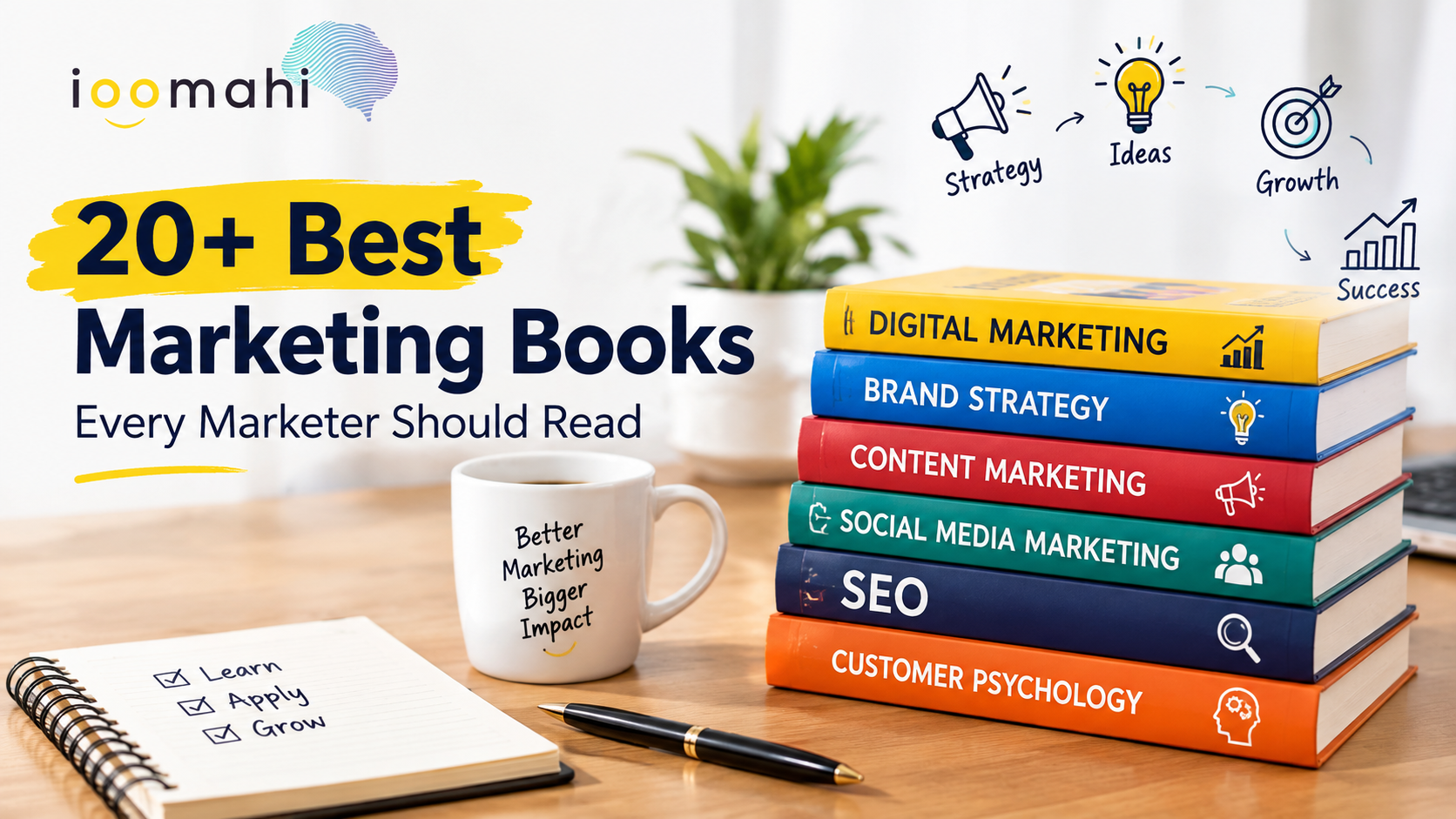
Marketing is constantly evolving, but the fundamentals of understanding customers, building brands, creating compelling messages, and driving business growth remain essential. Whether you are a beginner, digital marketer, content strategist, entrepreneur, brand manager, or experienced marketing professional, the right books can help you develop stronger strategies and a deeper understanding of consumer behavior.
From classic marketing principles to modern digital strategies, there are countless books that can improve your marketing knowledge. In this guide, we explore 20+ best marketing books that every marketer should read, covering branding, consumer psychology, advertising, storytelling, digital marketing, sales, positioning, and business strategy.
1. This Is Marketing – Seth Godin
Seth Godin’s This Is Marketing focuses on understanding people rather than simply trying to sell products. The book explains how marketers can create value by identifying specific audiences and solving meaningful problems.
It is particularly useful for marketers who want to understand positioning, customer needs, trust, and permission-based marketing.
2. Kotler on Marketing – Philip Kotler
Philip Kotler is widely recognized for his contributions to modern marketing education. Kotler on Marketing provides a broad overview of marketing concepts, including segmentation, positioning, customer relationships, branding, and strategic planning.
It is a useful reference for students, professionals, and business owners who want to strengthen their understanding of traditional marketing principles.
3. Influence: The Psychology of Persuasion – Robert B. Cialdini
Understanding why people make decisions is an important part of marketing. Robert Cialdini’s Influence explores psychological principles that can affect human behavior and decision-making.
The book introduces concepts such as social proof, authority, reciprocity, scarcity, commitment, and liking. These ideas are widely relevant to advertising, sales, content, and conversion optimization.
Read here – Digital Marketing vs Traditional Marketing – Ultimate 2026 Guide
4. Contagious: Why Things Catch On – Jonah Berger
Why do some products, ideas, and campaigns spread rapidly while others receive little attention?
Jonah Berger explores the factors that contribute to the sharing and popularity of ideas. The book is especially valuable for marketers working in social media, content marketing, brand campaigns, and word-of-mouth marketing.
5. Building a StoryBrand – Donald Miller
Clear communication is at the heart of effective marketing. Building a StoryBrand presents a framework for communicating a company’s message in a way that is easier for customers to understand.
The book is particularly relevant to businesses struggling with website messaging, brand positioning, advertising copy, and marketing communication.
6. Made to Stick – Chip Heath and Dan Heath
Some messages are remembered long after people encounter them, while others disappear almost immediately.
Made to Stick examines why certain ideas are memorable and explains principles that can help marketers communicate information more effectively. It can be useful for advertising, presentations, content creation, and brand storytelling.
7. Positioning: The Battle for Your Mind – Al Ries and Jack Trout
Positioning is one of the most important concepts in marketing. This classic book explores how brands can establish a distinctive position in the minds of consumers.
It remains relevant for marketers working on competitive differentiation, brand strategy, product launches, and category positioning.
8. Ogilvy on Advertising – David Ogilvy
David Ogilvy is one of the most influential names in advertising history. Ogilvy on Advertising provides insights into advertising principles, copywriting, creative campaigns, research, and brand communication.
The book is especially useful for advertising professionals, copywriters, creative teams, and brand marketers.
9. The 22 Immutable Laws of Marketing – Al Ries and Jack Trout
This book presents a collection of marketing principles focused on competition, leadership, perception, focus, and positioning.
While marketing has changed significantly since the book was published, many of its strategic ideas continue to generate discussion among marketers and business leaders.
10. Purple Cow – Seth Godin
In crowded markets, simply having a good product may not be enough to attract attention.
In Purple Cow, Seth Godin encourages businesses to develop products and marketing ideas that are remarkable enough to stand out. The book is particularly relevant to startups, entrepreneurs, product marketers, and creative professionals.
11. Everybody Writes – Ann Handley
Content has become a major component of modern marketing, and strong writing can influence how audiences perceive a brand.
Ann Handley’s Everybody Writes provides practical guidance on creating useful and engaging marketing content. It can help content marketers, social media managers, email marketers, and business writers improve their communication.
Read here – Best Digital Marketing Companies
12. Jab, Jab, Jab, Right Hook – Gary Vaynerchuk
Social media marketing requires more than simply publishing promotional posts.
Gary Vaynerchuk’s book explores how brands can create content suited to different social platforms while balancing value-driven communication with promotional messages.
It is particularly relevant for marketers managing social media campaigns and brand communities.
13. Epic Content Marketing – Joe Pulizzi
Content marketing can help businesses attract and retain audiences by consistently providing useful information.
Joe Pulizzi’s Epic Content Marketing discusses how businesses can develop content strategies, identify audiences, create valuable content, and build long-term relationships with customers.
14. Permission Marketing – Seth Godin
Traditional advertising often interrupts consumers with messages they did not request. Permission Marketing explores a different approach: earning the audience’s attention and permission to communicate with them.
The principles are relevant to email marketing, customer relationships, personalization, and digital communication.
15. The 1-Page Marketing Plan – Allan Dib
Marketing can become complicated when businesses do not have a clear strategy.
Allan Dib’s The 1-Page Marketing Plan offers a simplified framework for organizing marketing activities around customer acquisition, conversion, and retention.
It can be particularly helpful for small businesses and entrepreneurs looking for a structured marketing approach.
16. Blue Ocean Strategy – W. Chan Kim and Renée Mauborgne
Instead of competing directly in crowded markets, businesses can sometimes create new market opportunities.
Blue Ocean Strategy explores how organizations can pursue differentiation and value creation while reducing direct competitive pressure. The ideas can be useful for product strategy, business development, and market positioning.
17. Alchemy – Rory Sutherland
Rory Sutherland challenges conventional assumptions about consumer behavior and marketing decision-making.
Alchemy explores why people do not always behave according to traditional economic logic. It encourages marketers to consider psychology, perception, emotion, and unconventional approaches when developing campaigns.
18. How Brands Grow – Byron Sharp
Byron Sharp’s How Brands Grow examines marketing through the lens of empirical research and consumer behavior.
The book discusses concepts such as mental availability, physical availability, customer acquisition, and brand growth. It is particularly interesting for marketers who want to explore evidence-based approaches to brand building.
19. The 4-Hour Workweek – Timothy Ferriss
Although not exclusively a marketing book, The 4-Hour Workweek includes ideas relevant to entrepreneurship, product creation, customer research, outsourcing, and business development.
Entrepreneurs and marketers can find useful perspectives on testing ideas and creating scalable business systems.
20. Crushing It! – Gary Vaynerchuk
Personal branding and creator-led marketing have become increasingly important in the digital economy.
Crushing It! explores how entrepreneurs and individuals can use social platforms to build personal brands and businesses. It covers platforms, content creation, storytelling, and audience building.
21. Hooked: How to Build Habit-Forming Products – Nir Eyal
For product marketers and digital businesses, understanding user behavior is critical.
Hooked introduces a framework for understanding how products can encourage repeated user engagement. The concepts can be applied to product design, customer experience, apps, and digital services.
22. Don’t Make Me Think – Steve Krug
Marketing does not end when someone clicks an advertisement. The experience that follows can significantly affect whether a visitor becomes a customer.
Steve Krug’s Don’t Make Me Think focuses on web usability and user experience. It is particularly useful for marketers involved in websites, landing pages, conversion optimization, and digital experiences.
23. The Boron Letters – Gary Halbert
Copywriting is one of the most important skills in direct-response marketing.
The Boron Letters contains lessons on writing persuasive copy, understanding audiences, developing offers, and improving marketing communication. It can be valuable for copywriters and marketers interested in direct-response techniques.
24. Scientific Advertising – Claude C. Hopkins
Published decades ago, Scientific Advertising remains an influential work in advertising history.
Claude C. Hopkins emphasizes testing, measurement, consumer understanding, and evidence-based advertising. Many modern performance-marketing principles reflect similar ideas about measuring results and optimizing campaigns.
25. The Psychology of Money – Morgan Housel
While The Psychology of Money is primarily a book about financial behavior, its exploration of human psychology can also provide marketers with useful insights.
Understanding how people think about risk, reward, status, and decision-making can help marketers better understand consumer behavior.
Read this – Best Email Marketing Tools
Why Marketers Should Read Marketing Books
Marketing changes rapidly because technology, platforms, consumer expectations, and communication channels continue to evolve. However, many fundamental principles remain relevant.
Reading widely can help marketers:
- Understand consumer psychology
- Develop stronger marketing strategies
- Improve advertising and copywriting skills
- Learn effective branding principles
- Create better content
- Understand customer behavior
- Improve positioning and differentiation
- Develop stronger digital marketing campaigns
- Learn from successful marketing case studies
- Think more creatively about business growth
How to Choose the Right Marketing Book
You do not need to read every marketing book available. Instead, choose books according to your current goals and professional responsibilities.
For Beginners
Start with books that explain fundamental concepts such as positioning, customer psychology, branding, and marketing strategy.
For Digital Marketers
Books covering content marketing, social media, copywriting, consumer behavior, and digital experiences can be especially useful.
For Brand Managers
Focus on positioning, brand growth, storytelling, differentiation, and customer perception.
For Entrepreneurs
Marketing strategy, customer acquisition, product positioning, personal branding, and business development should be key areas of study.
For Copywriters
Advertising classics and books focused on persuasion, storytelling, direct response, and effective writing can help develop stronger copywriting skills.
Key Takeaways
- Marketing books can provide both foundational knowledge and practical strategies.
- Consumer psychology is an important part of effective marketing.
- Branding and positioning help businesses differentiate themselves.
- Content and storytelling remain valuable across marketing channels.
- Classic advertising books can still offer useful principles.
- Digital marketers can benefit from combining traditional marketing knowledge with modern digital strategies.
- Reading across different marketing disciplines can develop a broader strategic perspective.
Conclusion
The best marketing books are not limited to a single area of marketing. The strongest reading list combines classic advertising principles, consumer psychology, branding, positioning, content marketing, digital strategy, copywriting, and business thinking.
Books such as This Is Marketing, Influence, Ogilvy on Advertising, Positioning, Made to Stick, Building a StoryBrand, and How Brands Grow can provide different perspectives on how brands communicate and grow. The key is not simply to read more books, but to apply useful ideas to real marketing campaigns, customer experiences, and business challenges.
For marketers in 2026, combining timeless marketing fundamentals with modern digital practices can create a stronger foundation for long-term professional growth.