- Shabhana s
- 2026 Trends, AI Development, App Development, business growth, Business Technology, Digital Transformation, Mobile Apps, Software Development, Tech Trends, Technology Trends, Web Design, Web Development
- 0 Comments
- 50 Views
Introduction
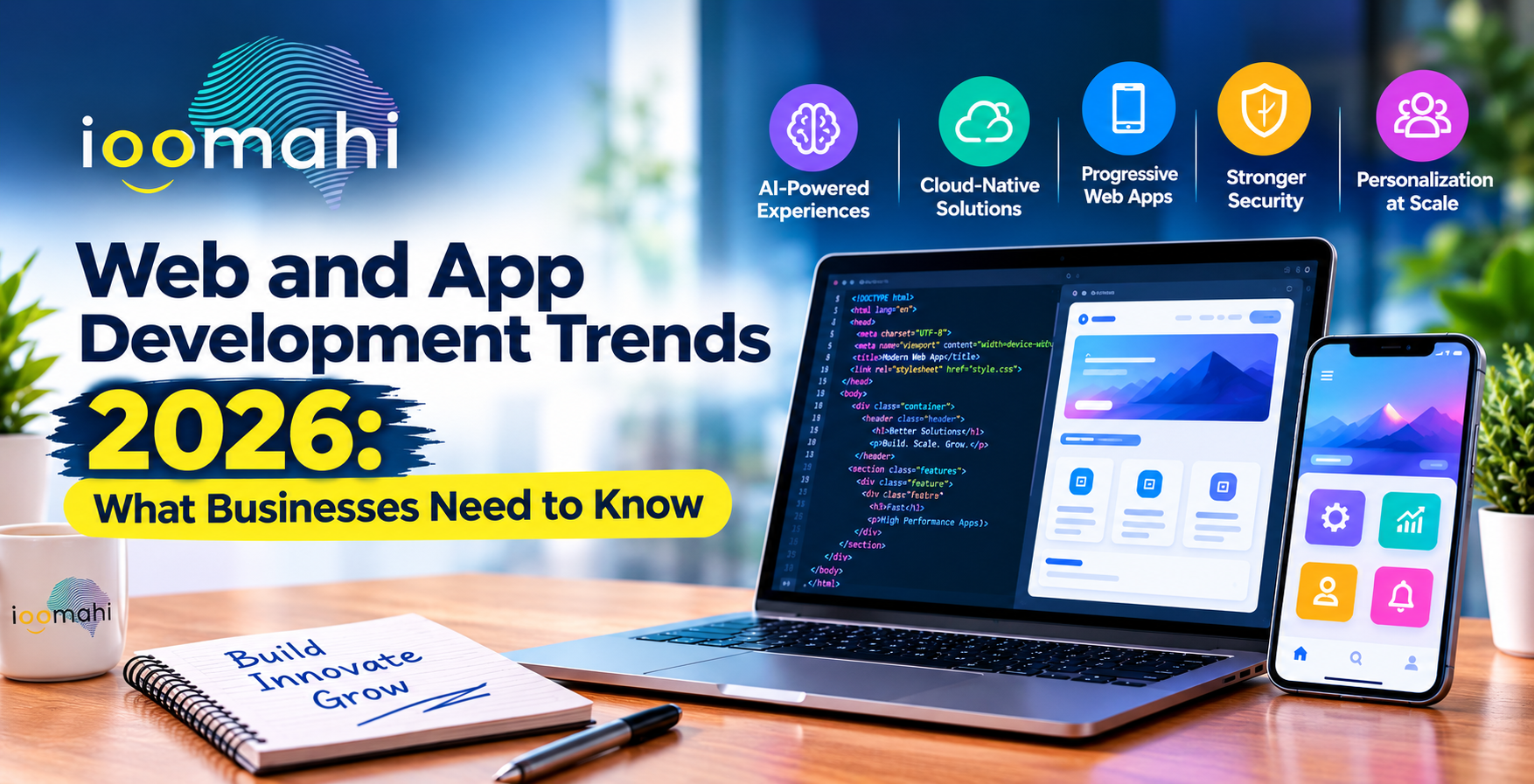
Web and app development are changing rapidly as businesses adopt artificial intelligence, cloud technologies, automation, stronger security practices, and faster digital experiences. In 2026, having a website or mobile application is no longer enough. Businesses need digital products that are fast, secure, personalized, accessible, scalable, and capable of adapting to changing customer expectations.
Artificial intelligence is also becoming part of the development process itself, helping teams generate code, test applications, identify issues, and accelerate development workflows. At the same time, technologies such as progressive web apps, edge computing, serverless architecture, modern APIs, and advanced cybersecurity are influencing how digital products are designed.
For businesses planning a new website, mobile application, or digital transformation project, understanding these web and app development trends in 2026 can help with better technology decisions, improved customer experiences, and long-term growth.
AI-Powered Web and App Development
Artificial intelligence is one of the biggest forces influencing software development in 2026. AI tools are increasingly being used throughout the development lifecycle rather than only as standalone features inside applications.
Developers can use AI-assisted tools to generate code, create documentation, identify bugs, write tests, analyze logs, and accelerate repetitive development tasks.
AI Features Inside Business Applications
Businesses are also integrating AI directly into their customer-facing products.
Common examples include:
- AI-powered customer support
- Intelligent search
- Personalized recommendations
- Automated content generation
- Document and data analysis
- Voice-based interfaces
- AI-powered business assistants
- Predictive analytics
However, businesses should not add AI simply because it is a popular technology. AI features should solve a specific customer or operational problem and provide measurable value.
AI Coding Agents and Developer Productivity
Another major development is the increasing use of AI coding assistants and agents. These tools can help developers work through larger portions of software-development tasks, including generating code, modifying existing files, creating tests, and investigating technical problems.
The shift is important because development teams can potentially spend less time on repetitive implementation work and more time on architecture, product decisions, testing, security, and user experience.
A 2026 survey of Indian developers reported strong adoption of AI coding agents alongside continued growth of TypeScript and Python, although this should be viewed as one survey rather than a universal measure of the entire developer ecosystem.
For businesses, the key consideration is not simply whether developers use AI. Companies should establish processes for code review, testing, security checks, privacy, and human oversight.
Read this: 10 Free Google Digital Marketing Courses & Certifications | Google Certified
Progressive Web Apps and Cross-Platform Development
Businesses continue to look for ways to reach users across multiple devices without maintaining completely separate technology stacks.
Progressive Web Apps, or PWAs, remain an important option because they can provide app-like experiences through the web while reducing some of the friction associated with traditional app installation.
Cross-platform frameworks are also attractive for businesses that want to build applications for multiple platforms while sharing a significant portion of their development effort.
Why Cross-Platform Development Matters
Cross-platform approaches can help businesses:
- Reduce duplicated development work
- Reach web and mobile users
- Simplify maintenance
- Speed up product launches
- Maintain more consistent user experiences
However, the best approach depends on the application’s requirements. High-performance or highly platform-specific applications may still benefit from native development.
Performance and Core Web Vitals
Website performance remains a major business priority in 2026.
Users expect pages to load quickly and respond smoothly, particularly on mobile devices and slower networks. A technically impressive website can still lose customers if pages are slow, interactions feel delayed, or important content takes too long to appear.
Businesses should therefore monitor real-world performance rather than relying only on development-environment testing.
Important performance areas include:
- Page loading speed
- Interaction responsiveness
- Layout stability
- Image optimization
- JavaScript efficiency
- Caching
- Content delivery
- Mobile performance
Performance optimization should be considered from the beginning of a project rather than treated as a final-stage task.
Edge Computing and Faster Digital Experiences
Edge computing is becoming increasingly relevant for applications that need low latency and geographically distributed performance.
Instead of processing every request from a centralized location, some workloads can be handled closer to the user. This can reduce latency and improve responsiveness for suitable applications.
Businesses operating globally, particularly those running real-time services, media platforms, e-commerce systems, and interactive applications, can benefit from evaluating edge-based architectures.
Serverless and Cloud-Native Architecture
Cloud-native development continues to influence how modern applications are built and deployed.
Serverless technologies allow development teams to run application logic without managing traditional server infrastructure for every workload. They can be particularly useful for event-driven systems, APIs, automation, and applications with variable traffic.
At the same time, cloud-native architectures can help organizations scale infrastructure according to demand.
However, serverless is not automatically the best choice for every application. Businesses should evaluate cost, performance, vendor dependency, observability, architecture complexity, and operational requirements before selecting it.
API-First and Headless Development
Modern businesses increasingly need their digital content and services to work across websites, mobile applications, connected devices, and other interfaces.
API-first development treats APIs as important products rather than simply technical connections between internal systems.
Headless architecture can also separate the content or business logic layer from the presentation layer. This gives organizations more flexibility when delivering content across multiple channels.
For businesses with multiple digital touchpoints, this approach can make future expansion easier.
Stronger Web Application Security
Cybersecurity is becoming an even more important part of web and app development.
The OWASP Top 10:2025 identifies risks such as broken access control, security misconfiguration, software supply chain failures, cryptographic failures, injection, insecure design, authentication failures, and software or data integrity failures among the most critical application security concerns.
This means businesses should not treat security as something added after development is complete.
Read this: Digital Customer Communication
Security Should Be Built Into Development
Organizations should consider:
- Secure authentication
- Strong authorization controls
- Data encryption
- Dependency monitoring
- Secure API design
- Regular security testing
- Logging and monitoring
- Secure software supply chains
- Vulnerability management
- Secure development practices
OWASP recommends integrating security into the development lifecycle and using appropriate standards and verification practices rather than treating the Top 10 as a complete security checklist.
Accessibility as a Business Requirement
Accessibility is becoming an increasingly important part of digital product development.
Websites and applications should be designed so that people with different abilities can navigate, understand, and interact with digital content.
Accessible development can include:
- Keyboard navigation
- Clear visual hierarchy
- Appropriate color contrast
- Descriptive labels
- Screen-reader compatibility
- Captions and transcripts
- Accessible forms
- Meaningful error messages
Accessibility can also improve usability for the broader audience, including users on mobile devices, older users, and people operating in different environments.
Personalized User Experiences
Customers increasingly expect digital experiences to be relevant to their needs.
Websites and applications can use customer preferences, behavior, purchase history, and contextual information to provide more personalized experiences.
Examples include:
- Personalized product recommendations
- Location-aware services
- Customized dashboards
- Relevant content suggestions
- Personalized offers
- Adaptive search results
Businesses should balance personalization with privacy and transparency. Collecting unnecessary data can create security, regulatory, and customer-trust risks.
Motion, Interaction and Modern User Experience
Modern web design is moving beyond static pages.
Micro-interactions, smooth transitions, interactive interfaces, and meaningful animations can make applications feel more responsive and engaging.
However, design should serve usability rather than distract from it. Excessive animation can increase page weight, reduce accessibility, and make interfaces harder to use.
The strongest digital experiences use interaction strategically to guide users through important actions.
Mobile-First Development Remains Essential
Mobile devices continue to play a central role in digital consumption. Businesses therefore need to ensure that websites and applications work effectively across different screen sizes and network conditions.
Mobile-first development means designing for smaller screens and constrained environments before expanding the experience for larger devices.
Businesses should pay attention to:
- Responsive layouts
- Touch-friendly controls
- Mobile navigation
- Fast loading
- Optimized images
- Simple checkout processes
- Mobile authentication
- Battery and data usage
What These Trends Mean for Businesses
The biggest lesson from the web and app development trends in 2026 is that technology decisions should be connected to business objectives.
Businesses should avoid adopting every new framework or technology simply because it is trending. Instead, technology choices should be based on customer needs, scalability, security, development resources, budget, and long-term maintenance.
For example, an e-commerce company may prioritize performance, personalization, payment security, and mobile experience. A SaaS company may focus more heavily on scalability, APIs, authentication, data security, and AI-powered workflows.
Read this: digital marketing courses solution
How Businesses Should Prepare for 2026
Companies planning a new digital product can take several practical steps.
1. Define Business Goals
Before selecting a technology stack, clearly identify what the website or application needs to achieve.
2. Prioritize User Experience
Make speed, accessibility, mobile usability, navigation, and simplicity part of the product strategy.
3. Use AI Strategically
Identify areas where AI can reduce costs, automate repetitive processes, or improve customer experiences.
4. Build Security Into the Process
Use secure development practices from planning through deployment rather than waiting until the application is finished.
5. Plan for Scalability
Choose an architecture that can grow with the business without creating unnecessary complexity.
6. Monitor Performance
Use real-world performance data to identify slow pages, inefficient processes, and technical bottlenecks.
7. Avoid Technology Hype
A popular technology is not automatically the right technology for every business. Evaluate its benefits, limitations, costs, ecosystem, and long-term support.
Key Points
- AI is becoming an important part of both software development and customer-facing applications.
- AI coding tools and agents can accelerate development, but human review and testing remain essential.
- Progressive Web Apps and cross-platform development can help businesses reach multiple platforms efficiently.
- Performance and mobile experience remain critical for customer satisfaction.
- Edge computing and cloud-native architecture can support scalable, responsive applications.
- API-first and headless approaches can make digital products more flexible.
- Cybersecurity should be integrated throughout the software development lifecycle.
- Accessibility and personalization are increasingly important parts of modern digital experiences.
- Businesses should select technologies based on objectives rather than trends alone.
Conclusion
The web and app development landscape in 2026 is becoming more intelligent, connected, performance-focused, and security-conscious. AI is changing both how software is developed and what digital products can offer, while cloud-native architecture, APIs, cross-platform development, edge computing, accessibility, and cybersecurity are shaping the technical foundation of modern applications.
For businesses, the goal should not be to follow every new technology trend. Instead, organizations should identify the technologies that directly improve customer experience, operational efficiency, security, scalability, and long-term business value.
Companies that combine thoughtful technology choices with strong user experience, performance, accessibility, and security will be better positioned to build digital products that remain useful and competitive beyond 2026.